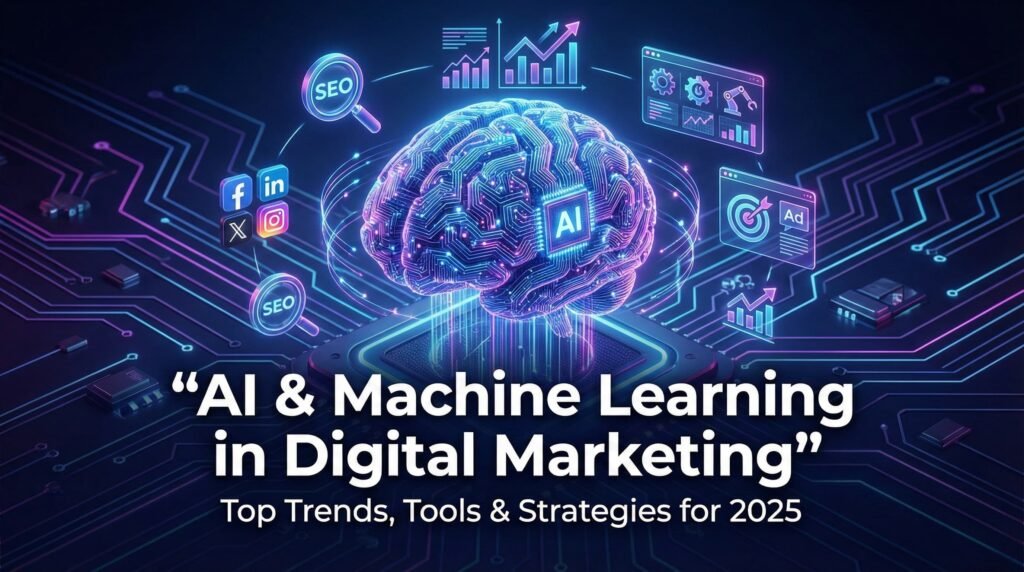
In 2025, artificial intelligence (AI) and machine learning (ML) are no longer futuristic buzzwords — they’re essential engines driving digital marketing success. Brands across industries are increasingly dependent on intelligent systems to refine strategies, personalize customer experiences, automate repetitive tasks, and extract actionable insights from massive data streams. But how exactly are AI and ML reshaping the digital marketing landscape? Let’s explore the most impactful trends, real-world applications, challenges, and strategies that marketers need to succeed in the age of intelligent marketing.
1. Why AI & Machine Learning Matter in Digital Marketing
Digital marketing has always been data-driven, but the exponential growth of data — across social media behaviors, search patterns, e-commerce interactions, and customer feedback — means traditional tools are no longer sufficient. AI and ML add unprecedented capabilities by:
- Automating complex decision-making
- Forecasting consumer behavior
- Delivering ultrarelevant personalization
- Optimizing campaigns in real time
According to recent industry reports, AI adoption in marketing is projected to grow more than 30% year-over-year as brands shift from experimentation to full-scale implementation.
2. Hyper-Personalization at Scale
One of the most transformative benefits of AI is its ability to analyze customer data and segment audiences with extreme precision. Gone are the days of broad demographic targeting.
Examples of AI-powered personalization:
- Dynamic content recommendations: Websites and emails that intelligently adapt content based on individual user behavior.
- Predictive purchase suggestions: E-commerce platforms proposing relevant products before users explicitly search for them.
- Behavioral triggers: Systems that send tailored messages based on user actions — like cart abandonment, browsing patterns, or engagement timing.
This level of personalization boosts conversion rates and customer loyalty. Studies show that AI-driven personalized experiences can increase engagement by as much as 50% or more.
3. Search Engine Optimization (SEO) Gets Smarter
AI is transforming SEO in significant ways:
a) Better Keyword Intelligence
Machine learning tools can identify not only keyword volume, but semantic intent — helping marketers optimize for topics rather than isolated keywords. This aligns with modern search engine algorithms, which prioritize relevance and context.
b) Automated SEO Audits
AI-powered platforms can run continuous website audits — scanning for broken links, site speed issues, content gaps, and schema errors with minimal human intervention.
c) Voice & Visual Search Optimization
Voice assistants and visual search are growing rapidly. ML enables marketers to optimize content for natural language queries and image-based searches — two areas traditional SEO tools struggled with.
4. Content Creation & AI-Assisted Writing
AI tools are no longer just catchy headlines. Platforms powered by large language models (LLMs) are now integral in:
- Drafting blog posts and web copy
- Generating social media captions
- Repurposing long-form content into bite-sized snippets
For example, AI can analyze your existing blog content and suggest new topics based on trending searches, competitor strategies, and user engagement patterns.
However, it’s important to remember that AI content still requires human oversight. Quality, context, tone, and brand voice remain core responsibilities of human creators.
5. Smarter Ad Campaigns with Predictive Targeting
Paid advertising is receiving one of the biggest boosts from AI and ML. Today’s ad platforms leverage predictive models that:
- Optimize bidding strategies in real time
- Forecast campaign performance
- Identify high-value audience segments
- Reduce wasted ad spend
For instance, AI can predict which users are more likely to convert based on historical behavior and target them with personalized ads — increasing ROI while lowering acquisition costs.
6. Customer Service Gets Intelligent
AI-driven chatbots and virtual assistants are now commonplace across websites, apps, and messaging platforms. These tools:
- Answer common customer queries instantly
- Route complex issues to human agents
- Offer product recommendations
- Provide support 24/7
Advanced AI systems can even interpret the emotional tone of messages, allowing more nuanced responses. This not only improves customer experience but also reduces support costs significantly.
7. Real-Time Analytics & Decision Making
In the past, marketers had to wait for weekly or monthly reports to assess performance. Today, AI dashboards provide real-time insights, enabling teams to:
- Adjust bids and targeting instantly
- Identify content topics gaining traction
- Spot drop-offs in conversion funnels as they happen
- Forecast next quarter’s KPIs with predictive accuracy
This real-time capability empowers marketers to be agile and data-driven rather than reactive.
8. Ethical Considerations & Data Privacy
With great power comes great responsibility. The rise of AI brings important ethical and regulatory challenges:
Privacy Compliance
Marketers must ensure that data collection follows global privacy laws like GDPR, CCPA, and emerging regulations across Asia and Europe. Transparency and user consent are paramount.
Bias & Fairness
AI systems can inadvertently produce biased outcomes if trained on skewed data. Marketers must audit AI algorithms regularly to prevent discriminatory targeting or exclusion.
Ensuring ethical AI not only protects brands legally, but also builds trust with consumers — a crucial currency in the digital age.
9. Preparing Your Digital Marketing Strategy for an AI-Driven Future
Here’s how organizations can embrace AI effectively:
a) Invest in the Right Tools
Choose platforms that integrate AI for analytics, content generation, personalization, and automation — but ensure they align with your business goals.
b) Train Your Team
AI expertise is becoming mainstream. Equip your team with skills in AI interpretation, prompt engineering, data analysis, and digital strategy.
c) Start Small & Scale Fast
Pilot AI projects on specific use cases (e.g., email personalization or predictive targeting) and measure performance before scaling across functions.
d) Focus on Human + Machine Collaboration
AI should augment your team’s creativity, not replace it. Humans will continue to shape strategy, brand identity, storytelling, and ethical decisions.
10. The Future is Already Here
AI isn’t just a future trend — it’s already transforming digital marketing across search, content, personalization, analytics, and advertising. Marketers who adapt quickly and ethically will thrive; those who don’t risk falling behind.
As we move deeper into 2025 and beyond, one thing is clear: AI is not the marketer of the future — it’s the marketer of today.